-
#15
by
ORCoaster
on 06 Jan, 2013 19:25
-
I find that when the engine is timed as you describe that the mileage is much better at either speed 55 or 70. You know you will get much better at 55 put really, who drives that speed anyway. Be real about it and figure the mileage at what you normally drive. Then bump it a bit and drive some more.
Be aware that about halfway through that second tank you will end up having to follow someone driving at 45 forever before you can pass and that will mess up the mileage comparison. How do I know that? It happens to me all the time. Plenty of miles but seldom the same driving style, wind resistance, traffic, lack of accidents and such. I keep a book in the glove box and record every fillup and miles driven and still I see the variability over time.
But I think you got it where it can't get much better.
-
#16
by
tyb525
on 06 Jan, 2013 19:45
-
OK heres the scoop on my 96,
There was no distinguishable cranking speed change with the CS lever pulled VS not pulled. I as well can detect a slight clatter tone change when going from CS lever not pulled, to pulled. Also, the cold start does seem to make a difference on the quality of the start when it is cold(go figure). After it started today I immediately pushed the lever back in and although it continued to run smooth, there was a miss or misfire on a couple cylinders for about 30-45 seconds or so. This cleared right up upon activation of the CS lever again.
This leads me to believe that my setting is not too far advanced. If it was i dont think there would be any change when you pulled the CS lever, am I correct in thinking this?
Wade
Yep that's where I'm at too
-
#17
by
libbydiesel
on 06 Jan, 2013 20:00
-
I'm assuming the smoke is due to injector lag, which is why dynamic advance is implemented; but over time, it seems that the dynamic advance is not as limber, due to wear, weaker delivery valves, low internal IP pressure and out-of spec injectors.
I agree will all except with a little reservation regarding the injectors. If the spray pattern is degraded, then they add to the smoke, but as they wear their break pressure lowers which advances the timing reducing smoke.
-
#18
by
wadem
on 07 Jan, 2013 07:27
-
8V
Will do, i will run a few tanks of fuel through it as is, then maybe play somemore. This is the third VW diesel i have owned, but the first with the adjustable IP sprocket.....what a great device!
Wade
-
#19
by
8v-of-fury
on 07 Jan, 2013 19:40
-
I just did a reseal, gp's, electric fuel pump and other stuff to my 88.. I have literally never timed one as advanced as I set this one up and it was a horrible bugger to start cold.
However I only set it to 0.040".. it was so advanced that it would not start cold at all. Literally two minutes of cranking or more and nothing would happen.. a quick turn over, but no catch. I was stumped for a day or two, but then tonight I retarded it substantially before even attempting a start, so it was stone cold. It fired up within two cranks, and ran like a dream immediately. So what I thought was a moderately aged 446,000 km engine.. is still extremely tight. lol
So there is a CON to overly advanced I just learned tonight..
-
#20
by
R.O.R-2.0
on 08 Jan, 2013 16:29
-
Pros to retarded are emissions, and sound as you have noticed. Diesels in the 80-90's were loud and smokey.. and not many liked them in North America because of what GM screwed up with the Detroits  (yeah yeah, keep it in your pants GM guys, they were not a good engine design lol!)
I and many others run at the same spot you are right now, to where it starts to clack-clack as if you poured marbles down the intake. You are right on the brink of too much timing, but that is ok because it can't really hurt anything unless you go way overboard!
Try this, on a cold start pull out your COLD START handle prior to cranking. Do you notice the engine turns slower then with it in? If so, you are right on the brink of injecting fuel too soon. If it does slow it down you are injecting fuel so early it is fighting the piston on its way up in the bore! Which is no good for starting, perfect for warming up as it will be part of the compression as well, and not so good for high rpm use as it will be again fighting the piston.
if you are talking of the 5.7/6.2/6.5L engines, those were NOT Jimmys (Detroit Diesels)
the 5.7/6.2/6.5 were based off gasoline Oldsmobile engines.. they were junk. they gave diesels a bad name..
Detroits have no injection pump, and no intake valves.. they are also 2 cycle, and supercharged..
GM designed Detroit diesels in 1937.. they really didnt change the design much over the engines whole run.. they added turbos and intercoolers/aftercoolers to them..
sure, its said that these engines ARE detroits.. but they are NOT.. these engines share NOTHING in common with any other detroit diesel..
-
#21
by
8v-of-fury
on 08 Jan, 2013 16:36
-
-
#22
by
TylerDurden
on 08 Jan, 2013 16:56
-
Regarded by Hotrodding Mag as one of the worst engines of all time...."The GM Corporate partners shared the grief associated with its diesel debacle of the early '80s. More often considered an Oldsmobile motor, this converted gasoline engine was used throughout the GM family, and even found its way into top-of-the-line Cadillacs, with disastrous results. Failures were commonplace, often including internal engine components. At the time, mechanics and service writers referred to warrantee repair orders as "A.F.A." - or Automatic Factory Acceptance, and each respective franchise had mountains of repair orders related to the 350 cid diesel." http://www.popularhotrodding.com/features/0408phr_worst_automobile_engines/
Oldsmobile produced various diesel engines during the 1980s. The Oldsmobile diesel gained a reputation for unreliability and anemic performance that badly damaged the North American passenger diesel market for the next 20 years.[1][2] However, the strong blocks continue to see use in petrol-powered race engines.[3][4]
LF9
The LF9 is a 350 cu in (5,737 cc) diesel V8 produced from 1978-1985. This converted gasoline engine was the subject of many warranty repairs.[5][6] Earlier versions and those used in pickups produced 120 hp (89 kW) and 220 ft·lbf (300 N·m) torque, while later versions produced 105 hp (78 kW) and 205 ft·lbf (278 N·m) torque.
Applications;
350N 1978–1985 Chevrolet, Buick, Oldsmobile, Pontiac, Cadillac, and Checker Marathon cars
350N 1978–1980 GMC and Chevrolet light trucks "pickups"
https://en.wikipedia.org/wiki/Oldsmobile_Diesel_engine
-
#23
by
tyb525
on 08 Jan, 2013 16:58
-
The 6.2/6.5 engine was not the same as the oldsmobile-based diesel. The 6.2/6.5 was a product of rushed design and production, but if they weren't abused and were taken care of, they would last
"This engine was never meant to be a power and torque competitor with Ford/International and Dodge/Cummins, but rather a simply designed workhorse engine that made credible power, achieved decent fuel economy and met emissions standards in half-ton trucks"
When people tried getting more power of them, is when they failed.
Detroit should've stayed with their 2-stroke diesel, that is what they are good at, unfortunately the epa hates them even more than 4-stroke diesels.
-
#24
by
8v-of-fury
on 08 Jan, 2013 20:49
-
Agreed, the 2 stroke stuff was and still is the bomb.. but unfortunately Detroit Diesel's name is also on the Oldsmodiesel lol.
-
#25
by
R.O.R-2.0
on 09 Jan, 2013 01:03
-
Agreed, the 2 stroke stuff was and still is the bomb.. but unfortunately Detroit Diesel's name is also on the Oldsmodiesel lol.
that does not make them REAL detroit diesels..
-
#26
by
tyb525
on 09 Jan, 2013 04:14
-
The 6.2/6.5 were designed from the bottom up as a new diesel engine, but the 5.7 was based on an olds engine.
-
#27
by
R.O.R-2.0
on 09 Jan, 2013 12:24
-
The 6.2/6.5 were designed from the bottom up as a new diesel engine, but the 5.7 was based on an olds engine.
yes, and all of them were JUNK..
and none of them shared ANYTHING in common with a detroit diesel...
if you called a 6.2/6.5, a JIMMY to anyone who knew anything, you would get slapped..
Detroit Diesel may have had SOMETHING to do with the design of the engine, but it is NOT a Detroit Diesel..
Screamin' Jimmys are Direct injected 2-cycle diesels..
a GM IDI is 4 cycle, and indirect injected, much like our VWs, and mercedes..
Any REAL detroit diesel, has a supercharger..
-
#28
by
tyb525
on 09 Jan, 2013 16:39
-
Totally agree with you there

It could've been a lot better if they had spent some time testing the engine, but they didn't, so they couldn't fix all the faults.
On another note, I discovered my cold start cable housing was pulled out of the bracket and wouldn't let me return the cold start quiet all the way back even though the knob was all the way in, so that explains why I was suddenly getting worse mpg's that last couple weeks (which I thought was the cold weather...).
Half a tank with it back to normal and my mileage is better.
-
#29
by
TylerDurden
on 09 Jan, 2013 16:50
-
I discovered my cold start cable housing was pulled out of the bracket... that explains why I was suddenly getting worse mpg's that last couple weeks
I saw that in your pix, but thought you were aware or in the middle of a procedure... :/
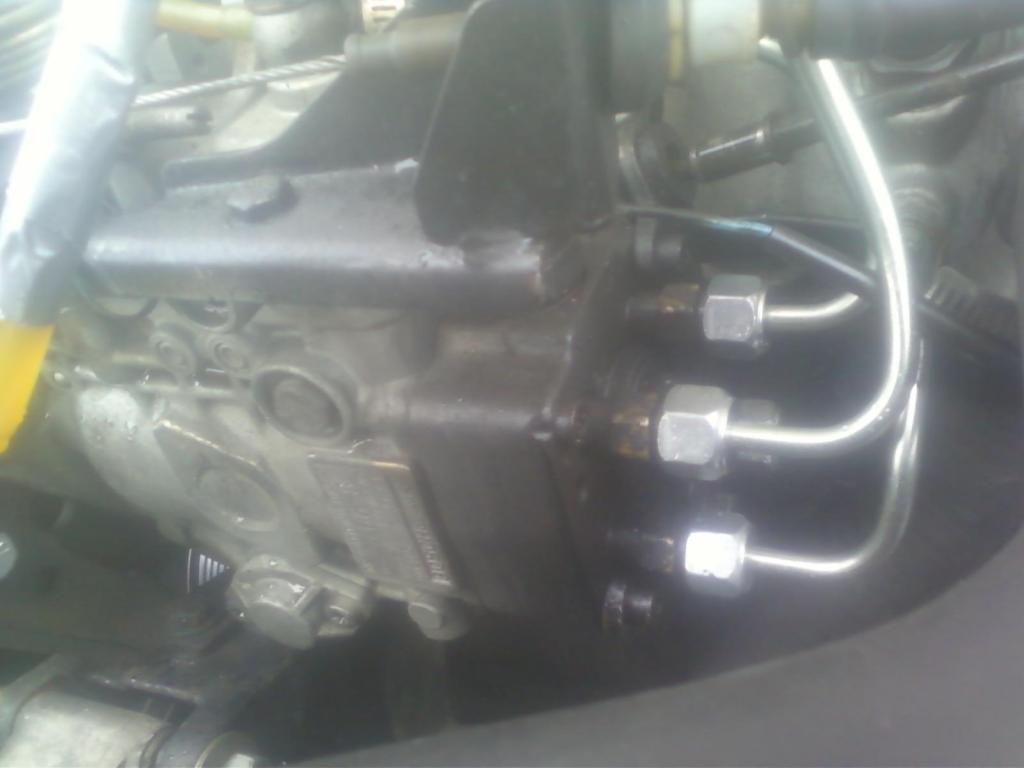
Really shouldn't make much difference, unless you idle or stop-go a lot.
