I will lift the engine in its place during the following days so I can start designing the boost pipes and the downpipe. In order to do so I need a head and some manifolds. Aki obliged..
A dummy 1.9 head was fitted on top of the block and the almost-complete inlet and exhaust manifolds could then be fitted on it.
My own special cyl. head is still being worked on, as it will have quite extensive modifications.

The exhaust manifold is ready apart from final polishing and the addition of an EGT probe. The manifold has a ceramic coating which should help reduce radiated heat, and also improve turbo response since more energy is channeled to the turbine housing.
That's a kind of an exhaust manifold you get by welding a T3 flange onto a N/A 1.9 cast iron manifold

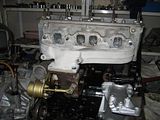

And there we have the little turbo.
It DOES look small next to the engine and manifold, doesn't it?
The turbine has ample clearance to the engine block ( a heat shield will fit there still ), but the compressor is "pretty close" to say the least.
If I manage to fit the waste gate assembly the way I like, I will clock the compressor housing so that it faces downwards. From there, I will route the boost pipe UNDER the gearbox to meet the FMIC. Yes it's cramped in there, but then the boost pipes only have 2" diameter which should help.


Next thing was naturally the fitment of the inlet manifold.
A pretty neat little package has been fabbed up from the 1Y factory inlet that was just sitting in a parts bin.
On the third picture you can see how the twin-plenum system is put together: The boost pipe is continued on the side of the plenum, partially IN the plenum actually. Then a small opening is machined to the pipe.
This design will keep any flow-back from the inlet tracts to a minimum.
It does look like a tight little hole through which the inlet air must flow, but once you calculate its surface area, it actually doesn't hinder flow much at all. All things considered, it can be clearly seen why these manifolds have been used on racing turbo engines since the group B rally cars. The flow to each port is made equal, back-flow is almost negated and total flow capacity remains good. More HP, more even fueling, less smoke and less strain on the engine.


