-
#60
by
Gizmoman
on 23 Nov, 2013 08:22
-
Thanks much for the clear explanation libby.
I dug out my light and was pleased to find this on the back end. Honestly, I never thought I'd be using this again - glad I didn't get rid of it.
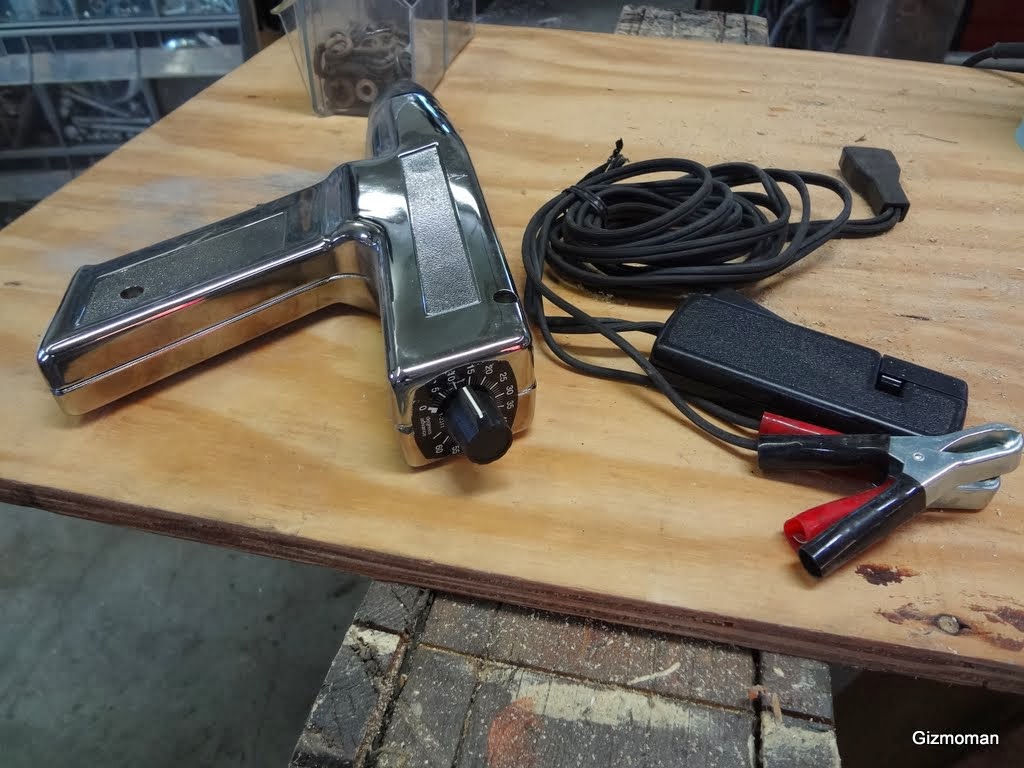
Hmmm, I just realized its an "advance" dial - bummer.
-
#61
by
Gizmoman
on 23 Nov, 2013 08:53
-
After doing a Google, all the timing lights I find with a dial are "advance" - I must be over-thinking again.
I am guessing that to fire the light at 12* BTDC, I need to "advance" the strobe of the light 12*? I figure that must be correct and I am just confusing the word advance. But how would the light fire BEFORE it gets a signal?
To me before top dead center is retarded timing and "advance" relates to after top dead center and what I want is a pulse (light) before 12*.
Man, my brain can be a real PITA sometimes.
-
#62
by
libbydiesel
on 23 Nov, 2013 09:16
-
If you glued a degree wheel to your crankshaft, then the degrees BTDC occur before TDC. :-) In other words, if you put a mark on the block and a mark representing TDC on your crank, then if you were turning the crank by hand in the direction of rotation when running, the side of the pulley before you get to TDC is BTDC. As you get farther from TDC in that direction you get more and more advanced. As you rotate the TDC mark on the crank past the reference mark on the block you are then in degrees ATDC (after TDC). As you get farther past, you get more retarded.
If you advance your timing, then the actual triggering event (pulse adapter or ignition signal on a gasser) occurs *before* TDC. The more advanced the triggering event, the higher the BTDC number. So, for a pulse occurring 12° BTDC, if the strobe is flashing at TDC, then it is occurring 12° *after* the trigger event that happened 12° BTDC... Einstein would have a field day with this relativity...
-
#63
by
TylerDurden
on 23 Nov, 2013 10:50
-
IIRC, the dial on the light delays the blink to read the amount of distributor advance. Turn dial until zeros on engine line-up and read the setting of the dial.
Aside...

0= TDC
A= ATDC
B= BTDC
-
#64
by
libbydiesel
on 23 Nov, 2013 11:21
-
Just bear in mind that the crank pulley rotates CW whereas that pic shows CCW rotation.
-
#65
by
Gizmoman
on 23 Nov, 2013 11:55
-
First, I have to say that your patience with this is simply awesome - everyone!
I have the timing set at TDC using the tube in GP method - flawless.

I verified it with the cam and both are spot on.
So I moved on to mark the flywheel/pressure plate. Too bad the new larger set-up works out the way it does but oh well - it seems to move the van with more strength than the stock one did. Anyway, the cast arrow in the bell housing was quite a ways away so I drilled the bellhousing for an .095 stainless welding rod. Then I made a pointer

.
I have epoxied the pointer in place and marked the pressure plate with white fingernail polish - TDC.

As soon as the epoxy sets, I'll move on to the IP and figuring which way it needs to bump.
Thanks again for the patience and clarification.
-
#66
by
TylerDurden
on 23 Nov, 2013 11:59
-
Just bear in mind that the crank pulley rotates CW whereas that pic shows CCW rotation.
FTR, It's a symbolic flywheel.
-
#67
by
Gizmoman
on 23 Nov, 2013 13:03
-
OK,
I followed Vince's IP timing instructions to the letter and it appears that my pump was set at .125 instead of .095

This may explain why it was so sluggish off boost (?) I had to rotate the pump
away from the head to move it from .125 to .95 which is where I believe Gies recommends I set it.
IOW - no timing belt "bump" required.
I will remove the gauge, install the valve cover and get it ready for a road test (after I turn it over by hand several times). I'll let keep you posted.
-
#68
by
745 turbogreasel
on 23 Nov, 2013 13:57
-
IIRC, the dial on the light delays the blink to read the amount of distributor advance. Turn dial until zeros on engine line-up and read the setting of the dial.
I find it most efficient to set the number on the gun to the desired setting, then rotate the distributor till the pointer lines up with 0 (which always has the most readable mark).
-
#69
by
Gizmoman
on 23 Nov, 2013 14:01
-
IIRC, the dial on the light delays the blink to read the amount of distributor advance. Turn dial until zeros on engine line-up and read the setting of the dial.
I find it most efficient to set the number on the gun to the desired setting, then rotate the distributor till the pointer lines up with 0 (which always has the most readable mark).
I assume you mean the IP?
-
#70
by
TylerDurden
on 23 Nov, 2013 15:38
-
Well yes... the light as used in gassers would be relating to the distributor. In those cases, checking the mech or vac advance would be a reading (after setting the static ignition timing).
In the case of the IP, I'd set the timing by dial gauge and take a reading with the light or vice-versa to get a baseline. (I'd check all lines for consistency.) Then, experiment to see where the engine runs best.
-
#71
by
Gizmoman
on 23 Nov, 2013 15:41
-
Wow - what a difference .95 makes instead of .125!

I was worried it would be tough to start but no problem
I still have an oil leak from the valve cover - guess it's time to try some sealant.
Other than that it runs great and really hits hard on boost (next will be the transmission).
My EGT's are getting much higher than I wanted. I'm hitting 1100F (my warning light threshold) fairly easily when it's at 12 psi.
Should I back off on the fuel screw a bit?
Possibly the timing? If so, which way would I rotate the pump to lower EGT's?
-
#72
by
libbydiesel
on 23 Nov, 2013 16:09
-
Because you are intercooled, increasing boost will reduce EGTs. Also, correct timing results in easy starts. Overly advanced or overly retarded timing results in hard starts.
-
#73
by
Mark(The Miser)UK
on 23 Nov, 2013 16:16
-
Diesel strobes can go both ways, but gasser one's work by varying [increasing]the delay of the strobe relative to the pulse [spark] to bring the timing mark into view.
I suspect that true diesel strobes are looking at a series of pulses, and not just the one you think it's looking at hence the price differential.
EDIT:Ha I began writing this 6 hours ago, before jobs got in the way
-
#74
by
Gizmoman
on 23 Nov, 2013 16:22
-
Because you are intercooled, increasing boost will reduce EGTs. Also, correct timing results in easy starts. Overly advanced or overly retarded timing results in hard starts.
Thanks libby, I read that I should keep the boost below 15 (which is where it was before the rebuild) while I'm breaking it in.
What are your thoughts on that? I could easily crank it up to 15 if needed.
Mark, As for my timing, I'm still waiting for my pulse sensor to arrive so I'm not using a light right now. I just found out today that I had the pump set at .125
It's rotated to .095 now and has a bit more off-boost grunt.
BTW, this explains why it wouldn't rotate CCW
