-
#15
by
kane66
on 23 Sep, 2008 11:59
-
what do you mean by bagged out.... lots of miles.
I'll be very interested in seeing how your millage is doing after the install. I'm looking at getting as much hp out of mine "eventually" while keeping the millage the same. Kinda like having your cake and eating it too.
-
#16
by
saurkraut
on 23 Sep, 2008 13:07
-
Bagged out was a poor choice on my part. I should have said virtually no piston rings.
I appreciate your interest. But honestly, I probably won't have any mileage figures that will be of any use to you, as every stop sign is a drag race, every turn Daytona, and speed limits are advisory in nature. It will be a rare occurance for this engine to be at steady state, max conserve.
As a mater of fact, my next major acquisition is going to be a six speed trans, as the 'tall' FF i have now runs out of gears at my desired cruising speed.
-
#17
by
saurkraut
on 26 Sep, 2008 10:30
-
I decided that I needed one of these
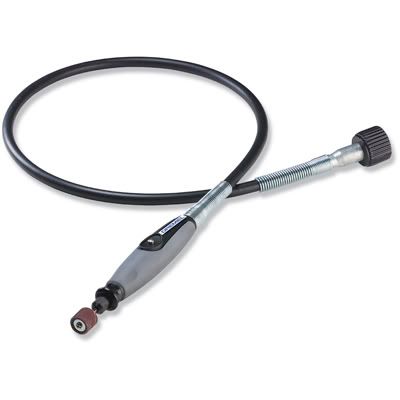
I need it to get all they way into the port from both directions.
And one of these 9934 Structured Tooth Tungsten Carbide Cutter (Cone)

Its a really weird tool. Works nice on aluminum, and didn't load up if you just let it do its thing.
Really helped smoothing up the rough cuts from this bad boy.

The Tungsten Carbide Cutter is the real hog. Makes the chips fly.
Tonight is the final smoothing and polishing with emery cloth on a metal stick in an electric drill. Then its off to be plained.
-
#18
by
saurkraut
on 29 Sep, 2008 06:13
-
To keep stuff from growing in the hole, I back filled the plugged oil drain with 5 Min. Epoxy.
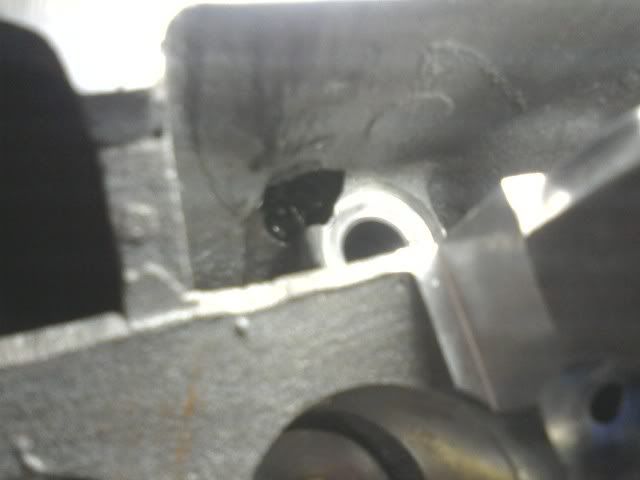
I cut the double syringe in half. Squirted them both in the blister from the package and mixed it up.
My big plan was to pour the mixture into one of the syringes and inject it into the hole, but there is a step in the id of the syringe bore, so you can't pull the plunger all the way out.
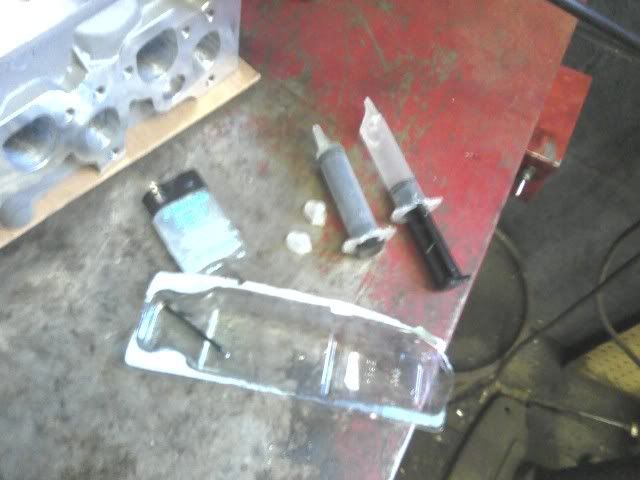
So I just sucked it up with one of the syringes, and injected it down the hole. Took three evolutions to fill it, the 5 Min. Epoxy remainedand liquid the hole time, and there was only a little left over.
The head is out gettting plained this week.
-
#19
by
zukgod1
on 29 Sep, 2008 06:45
-
I did the same thing, filled the hole with JB quick.
Well I didn't fill it and I probably should have but I capped the weld with it about 1/2" thick.
-
#20
by
monomer
on 29 Sep, 2008 14:05
-
I'm not getting it, it's not clicking for me....
I thought the aaz/1.9 would bolt directly to the 1.6/1.5 block with the only problem being the oil drain (and people seem to clog it with gasketing material?)
I plan to do this setup, help a n00b out? I've been doing my research - but theres a lot of it to make this engine work.
-
#21
by
zukgod1
on 29 Sep, 2008 14:12
-
I'm not getting it, it's not clicking for me....
I thought the aaz/1.9 would bolt directly to the 1.6/1.5 block with the only problem being the oil drain (and people seem to clog it with gasketing material?)
I plan to do this setup, help a n00b out? I've been doing my research - but theres a lot of it to make this engine work.
You better do LOTs of reading, the info is here.
There is a oil drain and a coolant port that overlap through the gasket, both need addressed.
saurkraut and I have both done/ doing the solid lifter block and the hydro head swap. mine is up and running and saurkraut is building his now.
If you are doing a full hydro engine it's s drop on gasket, if you have a solid lifter anything it adds to the complication.
If you need start up a build thread of your own to ask questions so we don't clutter up saurkraut's thread.
-
#22
by
saurkraut
on 06 Oct, 2008 13:12
-
The head is now plained so the plug is flush.
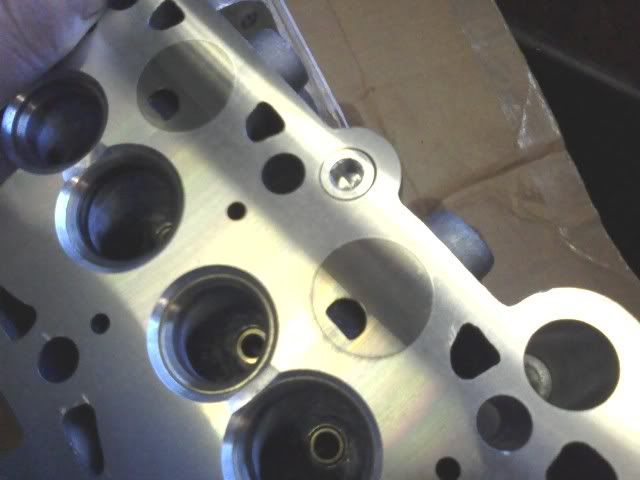
My prior valve figuring was faulty. The Exhaust valve is a no brainer, the exhaust valve from the Mech. head will go right in.
But the intake is another matter. Diesel heads are thicker than gasser heads, so Mech. gasser valve are too short.
The Mech diesel valves are 104mm long, Hydro Diesel valves are 96mm long. Mech gasser valves are 98mm long, so they're way too short.
I looked through a whole pile of Bentlies, and found the the only valves that were close on length and head diameter to be used as intake valves for my project are over sized VR6 exhaust valves. They're length is 106mm. All i have to do is nip them down to 104mm and thats set
The head diameter of the 1.9 hydro valves is 35.95, oversized VR6 exhaust valves from Techtonics are 35.8. I have to change all the intake valve guides to 7mm, but hey, I have a solution.
I stipped down a VR6 head, so I have 7mm springs, keepers and collets.
I think my next two weekends are clobbered, but there is light at the end of the tunnel.
-
#23
by
saurkraut
on 06 Oct, 2008 13:57
-
Krap,
Called Tectonics about the VR6 oversized valves. If I shorten them, the top notch for the colletts will be almost gone.
They said there is place making mechanical repacement lifters for hydro heads:
Mechanic Follower for VW 8v Hydraulic Heads
Wow, would have been nice to know....
-
#24
by
bugnut
on 06 Oct, 2008 17:20
-
So does this mean that we don't need to make the aluminum shims to change the valve spring seat now. All we need to do is buy these lifters and we are good to go or do I have this all wrong? I plan on running a 1.9 on my 1.6 and I am now getting my parts lined up.
-
#25
by
saurkraut
on 07 Oct, 2008 05:15
-
The mechanical replacement lifter appears to be the best solution for making a 1.9 head mechanical.
For a 1.6 head, hydro to mechanical, its a toss up.
-
#26
by
arb
on 07 Oct, 2008 12:37
-
How hard do you think the start will be with the lower compression. Also I heard that reducing the compression increases MPG's, do you know if that's true.
All other things being equal, lower compression = less HP per gallon of fuel = lower MPG.
Its part of the reason our diesels will always be more efficient (about 40% more) than gas engines. They can't go much higher than 13:1, and then with very high octane fuel.
Ford is splitting the difference with what they call and EcoBoost - I call it a gasoline diesel because it is a direct injected engine with spark plugs. So, they have all the high priced parts a TDI has, but not the high compression. They therefore only get to a claimed 30% better efficiency than a conventional gas engine.
-
#27
by
Turbinepowered
on 07 Oct, 2008 12:46
-
How hard do you think the start will be with the lower compression. Also I heard that reducing the compression increases MPG's, do you know if that's true.
All other things being equal, lower compression = less HP per gallon of fuel = lower MPG.
You start hitting diminishing returns around 17:1 compression. Our IDI diesels are so extremely high compression because of the necessity for cold starts and the high exposed surface area the prechamber design lends to the combustion spaces.
The 17:1 mark, incidentally, is roughly where most industrial and over the road diesels operate; I'd think if anything higher would give them performance gains on less fuel, the trucking industry would be all over it!
-
#28
by
kane66
on 07 Oct, 2008 14:08
-
Thanks a lot Arb and Turbinepowered, I don't remember where I read that, but it's nice to clear up some of my disinformation.
saurkraut... If that stripped down vr6 head is a 12v you wouldn't be interested in selling at a good price would you......
-
#29
by
arb
on 08 Oct, 2008 11:03
-
The 17:1 mark, incidentally, is roughly where most industrial and over the road diesels operate; I'd think if anything higher would give them performance gains on less fuel, the trucking industry would be all over it!
There is another factor at about 17:1 - the NOx levels go way up as you increase the compression ratio. Over the road has emission standards these days too.
Here is a physics based expression. If you plug in the numbers you will find that a 23:1 is more efficient than a 17:1 engine.
http://hyperphysics.phy-astr.gsu.edu/Hbase/thermo/diesel.htmlBut, these to not take into account the emissions of NOx.
To look at the other extreme, the Wright Brothers first engine of about 12 - 17 hp from 3.3L - only had a 4.5:1 compression ratio.