-
#15 by theman53 on 06 Feb, 2013 09:30
-
Yeah, that is how I thought of it too, but I don't see how it would effect oil pressure to the rest of the engine. Show me with pics.
-
#16 by TylerDurden on 06 Feb, 2013 14:47
-
Pics of a 1.9 vacuum pump.
Here's my understanding of the mechanism:
The vanes and hub are a close tolerance fit to the lid and form a seal at the top and bottom: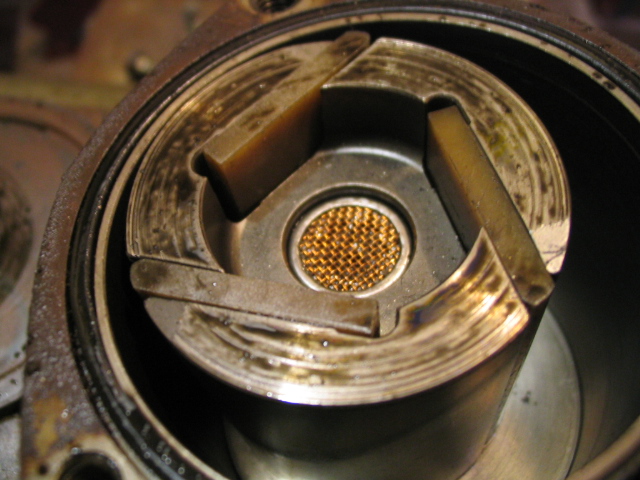
Oil directly from the pump (~100psi) flows up through the shaft, fills the space in the top of the hub and the hollows behind each vane and pushes the vanes out to sweep the walls of the chamber. The sweeping from small area to large draws in air from the check-valve in the lid:
The vanes push the air (and oil that pushes past the vanes/hub) into the opening in the side of the chamber:
(Note the recess surrounding the bore in the bottom of the chamber.)
The opening in the side of the chamber leads directly down by the bottom of the bore to lubricate the gear (light can be seen below the bore):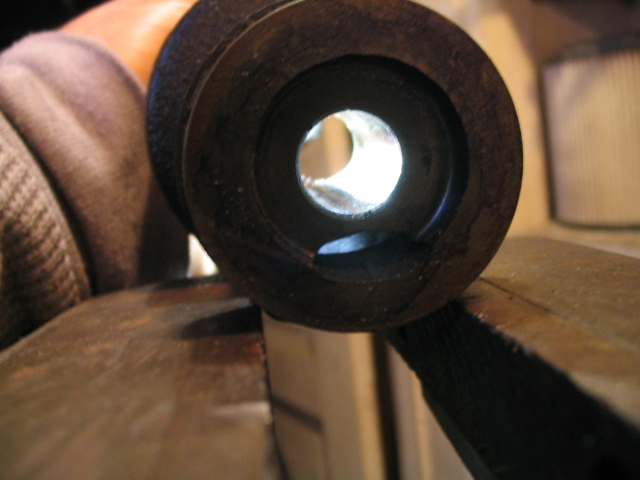
The recess in the bottom around the bore receives oil from the hollows behind the vanes, its diameter is large enough to receive oil that is pushing the vanes in each slot. It supplies oil to the helical groove in the shaft. (It is the dark area that can be seen at the bottom of the slot):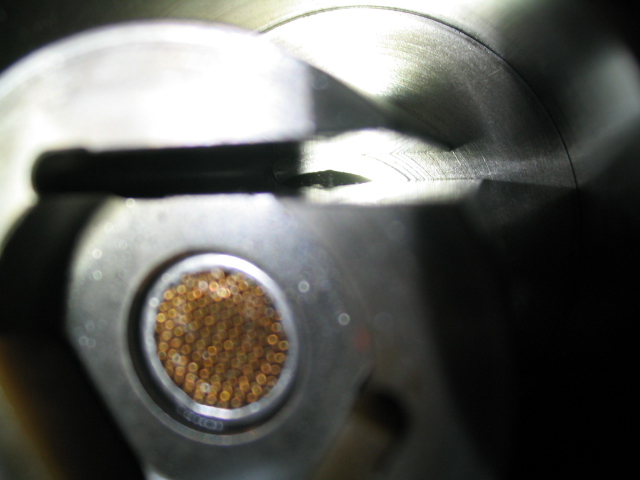
The shaft is grooved to deliver oil from the chamber recess to the bore walls: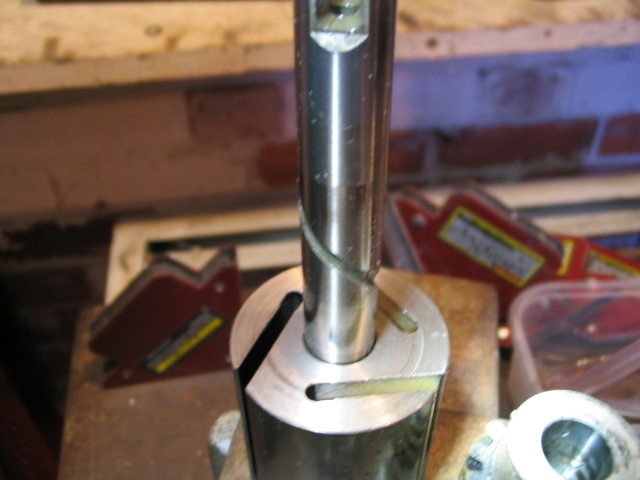
So, the vanes hold oil pressure, forcing it down into the helical groove. Any oil that gets past the vanes gets pushed out the opening in the side of the chamber along with the air drawn into the pump.
Taking out the vanes will let the oil flow unrestricted into the chamber and out the opening in the side. That could drop oil pressure the same way a bad seal at the bottom of the pump shaft could. Plugging the oil feed at the top of the hub will starve the shaft and the drive gear at its bottom.
-
#17 by theman53 on 06 Feb, 2013 14:58
-
So weld it up 99% of the way and call it good?
-
#18 by TylerDurden on 06 Feb, 2013 15:07
-
So weld it up 99% of the way and call it good?
I'd rather weld the side passage closed, then drill about a 1/16" hole in that plug. That would keep pressure for the shaft feed and shoot oil onto the drive gear. -
#19 by theman53 on 06 Feb, 2013 15:43
-
Or plug the nipple on top and change nothing?
-
#20 by R.O.R-2.0 on 06 Feb, 2013 16:42
-
I can leave the vacuum pump on, just would look allot cleaner if I could get rid of it. Also give me more room for steering shaft in the tractor if the pump wasn't there.
cut the top half of the pump off.. leave the shaft, and one of the bushings..
plug the hollow shaft.. its a passage for oil.. plug that, and you will be golden.
or, you can try and find the pieces for the diesel/manual brakes, but you may have a better chance of meeting Jesus Christ himself..
GOOGLE "dizzy grizzy"... thats the idea behind cutting the top half of the vac pump off..
why is your steering shaft THAT CLOSE to the engine?! you know you can rotate the vacuum pump almost 360*, and that should be enough to put it out of the way of your steering shaft.. besides, if you remove the vac pump, your steering shaft is gonna hit your oil filter, and oil feed lines.. then its gonna hit the alternator and water pump next..
i think i would take my chances with cutting up a vac pump.. or just poke holes in the diaphragm, and cap both ports.. -
#21 by TylerDurden on 06 Feb, 2013 17:24
-
plug the hollow shaft.. its a passage for oil.. plug that, and you will be golden.
Hrrrrrmmmm.... the shaft will burn up, it gets its lube from the top down and lubes the drive gear. (Check the pix.)
But if you want to disprove that theory, let us know how it goes. -
#22 by TUFFY on 06 Feb, 2013 18:08
-
The filter is a remote because original location would hit the frame rail. No alternator, rack and pinion steering in front, shaft and U joint go under water pump, then up next to engine near the vacuum pump then U joints to steering wheel. It clears the vacuum pump but its close, don't need pump so I though maybe I could just get rid of it.
-
#23 by CRSMP5 on 06 Feb, 2013 18:52
-
well in a few weeks.. ill have a 2.0 16v oil pump, block off plate.. gear... i have a 1.5 oil pump/gear but somehow missing the cap.. but 1.9 big hole.. so it would not fit anyways..
till i have 16v stuff i will not say it will work... gear wrong.. but big due to smaller im shaft for 1.9.. not going to be same as 1.5 gear size..
you may have to get the gear/im shaft from a 1.6/1.5 thinned out so the crank misses it.. so you can use the 16v pump, but 1.5 gear drive set up..
gear i refer too is on the im shaft.. back when people stroked the old non bubble block gaser to 2.0 they would thin out the drive gear so the crank would miss it.. -
#24 by TUFFY on 11 Feb, 2013 09:40
-
I cut apart a pump drive and can make it short but will have only the bottom bushing. I am worried there will be to much side load for just one bushing to handle though. What do you guys think?
-
#25 by R.O.R-2.0 on 11 Feb, 2013 16:52
-
I cut apart a pump drive and can make it short but will have only the bottom bushing. I am worried there will be to much side load for just one bushing to handle though. What do you guys think?
the block bushing is still there as well, isnt it? cause it takes a good portion of the load too..
the 16v/diesel just has a gear on the splined shaft, and no support bushing from above.. -
#26 by R.O.R-2.0 on 11 Feb, 2013 17:03
-
plug the hollow shaft.. its a passage for oil.. plug that, and you will be golden.
Hrrrrrmmmm.... the shaft will burn up, it gets its lube from the top down and lubes the drive gear. (Check the pix.)
But if you want to disprove that theory, let us know how it goes.
there is a notch in the IM shaft bearing that sprays oil on the gears..
you would be completely fine with just that one oiler.. -
#27 by TylerDurden on 11 Feb, 2013 17:16
-
plug the hollow shaft.. its a passage for oil.. plug that, and you will be golden.
Hrrrrrmmmm.... the shaft will burn up, it gets its lube from the top down and lubes the drive gear. (Check the pix.)
But if you want to disprove that theory, let us know how it goes.
there is a notch in the IM shaft bearing that sprays oil on the gears..
And the shaft above the gear? -
#28 by TUFFY on 12 Feb, 2013 15:54
-
I cut apart a pump drive and can make it short but will have only the bottom bushing. I am worried there will be to much side load for just one bushing to handle though. What do you guys think?
the block bushing is still there as well, isnt it? cause it takes a good portion of the load too..
the 16v/diesel just has a gear on the splined shaft, and no support bushing from above..
Yes the bushing is in the block, but the hole on the drive gear is not a close fit to the oil pump shaft so the drive gear can move around some on the oil pump shaft. -
#29 by TylerDurden on 12 Feb, 2013 16:25
-
The 8V gear relies on the upper shaft to keep the gear concentric and in proper mesh.
That hollow shaft has a slot that mates with a flat tang on the oil pump (not splines). The shaft needs oil feed at gallery pressure.