:shock: Just noticed in a book that for the hydraulic tappet gassers there is an RPM limiter built into the distributer to limit the RPM's to between 6150 and 6450 RPM. It states this is to prevent tappet damage :shock: ... :idea: Could this be a source of 'le Crunch' for some of you speed freaks? :idea:
:shock: Just noticed in a book that for the hydraulic tappet gassers there is an RPM limiter built into the distributer to limit the RPM's to between 6150 and 6450 RPM. It states this is to prevent tappet damage :shock: ... :idea: Could this be a source of 'le Crunch' for some of you speed freaks? :idea:
Those tappets are the same as came in 16v's with a factory rev limit of around 7000 rpm. There are also drag cars spinning in excess of 8000 rpm on the track without significant issues. I don't think the negative overlap diesel cam is going to allow anything close to that.

I don't think the negative overlap diesel cam is going to allow anything close to that.
hehe. :wink:
I've always heard 7000 is about the practical redline for VW hydraulic lifters. Never seen anything substantial to back it up though.
I don't think the negative overlap diesel cam is going to allow anything close to that.
hehe. :wink:
I've always heard 7000 is about the practical redline for VW hydraulic lifters. Never seen anything substantial to back it up though.
One of my other hangouts online is the Hardcore VW forum. I seem to recall "lugnuts" talking about lifters once upon a time so I went and looked up some details of his car:
http://cars.vwsport.com/lugnuts/Scroll down under engine and it lists "stock hydraulic lifters". That engine revs in excess of 8k RPM. I wouldn't expect the kind of longevity you get from a stock engine though.
7k sounds highly optimistic for the diesel cam. I don't think decent power can be made much beyond 5k RPM.
:shock: Just noticed in a book that for the hydraulic tappet gassers there is an RPM limiter built into the distributer to limit the RPM's to between 6150 and 6450 RPM. It states this is to prevent tappet damage :shock: ... :idea: Could this be a source of 'le Crunch' for some of you speed freaks? :idea:
I just saw this.
For what it`s worth, if you can bypass the rev limiter you mentioned TRW makes a low mass hydro lifter that is supposed to be good for another 1000-1200 RPM. I`ll post the part number in the morning.
N.
:shock: Just noticed in a book that for the hydraulic tappet gassers there is an RPM limiter built into the distributer to limit the RPM's to between 6150 and 6450 RPM. It states this is to prevent tappet damage :shock: ... :idea: Could this be a source of 'le Crunch' for some of you speed freaks? :idea:
I just saw this.
For what it`s worth, if you can bypass the rev limiter you mentioned TRW makes a low mass hydro lifter that is supposed to be good for another 1000-1200 RPM. I`ll post the part number in the morning.
N.
:mrgreen: :twisted: I have totally converted to diesels now and any 'new' gasser Quantums I buy will have their engines winkled out and one of my TD's put in :twisted: :mrgreen:
Since I found that rev counter in a big truck I have been amazed just how much time I spend at a mere 1250 to 1500 rpm
7k sounds highly optimistic for the diesel cam. I don't think decent power can be made much beyond 5k RPM.
If you haven't driven a VW IDI Diesel with a modded revv limiter, I can see how you might think the motor could never make usable power above 5k RPM.
As to the camshaft limiting RPM... I agree that there must be some limit, but what use is uninformed speculation?
Someone on this board has posted a dyno of their 1.9lTD that was still making some usable power up to nearly 7k RPM! Yes, that's the motor with the longer stroke, small turbo, and ~20% higher displacement. If such a motor can do that, what's stopping the "revv happy" 1.6, with smaller displacement, shorter stroke, and freer flowing turbo from doing even better at high RPM?
7k sounds highly optimistic for the diesel cam. I don't think decent power can be made much beyond 5k RPM.
If you haven't driven a VW IDI Diesel with a modded revv limiter, I can see how you might think the motor could never make usable power above 5k RPM.
As to the camshaft limiting RPM... I agree that there must be some limit, but what use is uninformed speculation?
Someone on this board has posted a dyno of their 1.9lTD that was still making some usable power up to nearly 7k RPM! Yes, that's the motor with the longer stroke, small turbo, and ~20% higher displacement. If such a motor can do that, what's stopping the "revv happy" 1.6, with smaller displacement, shorter stroke, and freer flowing turbo from doing even better at high RPM?
There's a difference between useable power and making peak power. If it makes peak power at ~5500 or whatever then why bother revving to 7k? Because you can? That would only serve to make the car slower. I'll type out a better response as soon as I can find the elusive diesel cam specs. I know they're out there and it had very negative overlap..
There's a difference between useable power and making peak power. If it makes peak power at ~5500 or whatever then why bother revving to 7k? Because you can? That would only serve to make the car slower. I'll type out a better response as soon as I can find the elusive diesel cam specs. I know they're out there and it had very negative overlap..
From Carrol Smith's "Drive to Win", p. 45: "For maximum performance you always have to shift past the peak of the horsepower curve."
There's a difference between useable power and making peak power. If it makes peak power at ~5500 or whatever then why bother revving to 7k? Because you can? That would only serve to make the car slower. I'll type out a better response as soon as I can find the elusive diesel cam specs. I know they're out there and it had very negative overlap..
From Carrol Smith's "Drive to Win", p. 45: "For maximum performance you always have to shift past the peak of the horsepower curve."
There's a difference between shifting at 5600 if the peak is 5500, but overreving it 1500 rpm would be pointless.
As long as the horsepower is higher than it would be in the next lower gear, it's quicker not to downshift.
There is also an added advantage in a racing situation to having an increased revv limiter when approaching a turn... it can be fastest sometimes in this case to hold the gear rather than upshift, even if it means "bouncing off the revv limiter" (and you see some very experienced racecar drivers do this). The reason is because upshifting necessitates an added downshift coming out of the turn. Missing a downshift takes time to do as well as a hand away from the steering wheel in the middle of the turn in a best case scenario, and in a worst case scenario, missing an downshift can add seconds to and wreck an otherwise great autocross run. That is why sometimes you see very knowledgeable autocross drivers "bounce the revv limiter" sometimes when approaching a turn, up until the braking zone.
All else being equal, a powerband that is more broad and more flexible for shifting is more desirable over a narrower powerband for roadracing/autocross. The benefits don't just apply to racing either, it is arguably even more important for street driving when attention is not always 100% on optimal shift timing and broad powerband makes navigating traffic easier and reacting to unexpected traffic events developing, etc.
As long as the horsepower is higher than it would be in the next lower gear, it's quicker not to downshift.
There is also an added advantage in a racing situation to having an increased revv limiter when approaching a turn... it can be fastest sometimes in this case to hold the gear rather than upshift, even if it means "bouncing off the revv limiter" (and you see some very experienced racecar drivers do this). The reason is because upshifting necessitates an added downshift coming out of the turn. Missing a downshift takes time to do as well as a hand away from the steering wheel in the middle of the turn in a best case scenario, and in a worst case scenario, missing an downshift can add seconds to and wreck an otherwise great autocross run. That is why sometimes you see very knowledgeable autocross drivers "bounce the revv limiter" sometimes when approaching a turn, up until the braking zone.
All else being equal, a powerband that is more broad and more flexible for shifting is more desirable over a narrower powerband for roadracing/autocross. The benefits don't just apply to racing either, it is arguably even more important for street driving when attention is not always 100% on optimal shift timing and broad powerband makes navigating traffic easier and reacting to unexpected traffic events developing, etc.
While I understand your point, I just don't think it's necessary when the TD makes peak torque at 1800 rpm. So, the curve is very flat with the power peak up at 4500...which you might be able to get a little higher with the governor mod and such. Still, it's a very flat, useable, and wide power band. Revving it higher seems like unjust punishment.
1800 RPM torque peak? Sounds like you are confusing the power curve of a TDI.
The power curve plot of a stock 1.6lTD, as provided in the VW TD SAE Paper #830441, shows that torque peaks at 2600RPM (or, based on my testing, when boost pressure initially reaches maximum):
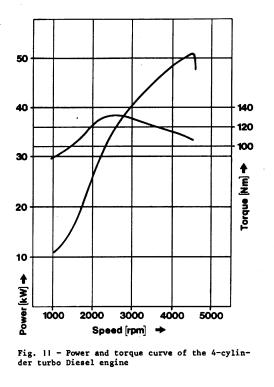
The stock power curve is also not flat; it is upwardsly-increasing.
I also agree that if you are just puttering around town and only drive a diesel because you are cheap, highly concerned about engine wear, or only drive a diesel for the fuel economy, it makes sense to keep loads high and therefore to short-shift and not wind the engine up. But if that is true, then why are you wasting your time in the "IDI Engine performance" section of GTD Forum?
How is torque on that 1.6td up at 130lb-ft when the 1.9td is only rated for 107lb-ft. Am I missing something here?
Farkman - the german researchers who published the paper apparently prefer metric units. 1 Newton-meter is 0.7375 Foot-pounds.