For years, the 2 cycle diesel engine powered everything from small industrial equipment to locomotives to large ships. 2 cycle diesel engines powered tanks and boats that helped the allies go on to win WW2. 2 cycle diesel engines powered the Greyhound buses that carried freedom riders throughout the south. Many hospital backup generators use 2 cycle diesel engines.
The lowdown on the 2 stroke dieselLike a gasoline 2 cycle engine, the diesel 2 cycle has, obviously, 2 cycles; the compression cycle and the power cycle. But unlike a 2 cycle gasoline engine, the 2 cycle diesel has a conventional wet sump lubrication system. Since the power cycle isn't used to pressurize the air/fuel mixture in the sump as is done in a 2 cycle gasoline engine, the 2 cycle diesel needs another method of pressurizing the intake air. An engine driven supercharger (usually a Roots) takes care of this. However unlike a performance engine supercharger, the supercharger on a 2 cycle diesel only needs to pressurize the air a few PSI above ambient pressure.
The compression and power cycles of a 2 cycle diesel are pretty much the same as those in a 4 cycle diesel: air is compressed and fuel is injected. At the end of the power cycle, when the piston uncovers the intake ports, it creates a swirling effect that pushes the exhaust out valves in the cylinder head. This is a process called scavenging.
 Basic design of a 2 cycle diesel.
One of the benefits of the 2 cycle diesel is the wide power band it provides. They will produce useable power up to it's governed RPM and will run like that all day, while in most 4 cycle diesels, the power drops sharply before it reaches it's governed RPM. For example, a typical 4 cycle diesel in a semi truck's "sweet spot" (where it produces the power most efficiently) is between 1200 and 1700 rpm despite it having a governed RPM at 2100 rpm. OTOH, in a 2 cycle, it might be between 1200 and 2100 rpm. A 2 cycle diesel can run all day at it's maximum RPM without missing a beat. Thats why 2 cycle engines in buses ran so well with 4 and 5 speed transmissions, the wide gear steps didn't cause it to run out of it's power band, unlike in a 4 cycle, which would need at least 6 gears to run efficiently.
2 cycle diesels can also be turbocharged. The turbocharger feeds into the supercharger. These are known in trucking circles as "huffer and puffer engines. Often a jacket water aftercooler is mounted between the supercharger and intake ports.
2 cycle diesel engines are also able to produce more power for their size compared to similarly sized 4 cycle diesels. For example: a 750 cubic inch turbocharged 2 cycle diesel can produce the same power as a turbocharged 850 cubic inch 4 cycle diesel
There are a few drawbacks. 2 cycle diesels aren't able to produce as clean emissions as their 4 cycle brothers. They also tend to consume larger amounts of oil. This is due to the design of the 2 cycle engine. Since the intake ports are in the sides of the cylinder, the rings of the piston go past them. This allows engine oil to be consumed at a higher rate than a 4 cycle engine. Consequently, this prohibits cleaner emissions. This also requires the use of a low sulfated ash lubricating oil in the sump. Using an oil with a high level of sulfated ash can leave deposits in the exhaust ports. Usually SAE 30 and 40 single weight oils are specified, though newer "mixed fleet" 15W40 multigrade oils are also sufficient for use in 2 cycle diesels.
Detroit Diesel: The King of 2 cycle dieselsOne engine company has a name that's synonimous with 2 cycle diesel technology: Detroit Diesel. Detroit Diesel's history dates back to 1938 when it was formed as GM diesel division.
One of the first engines they produced was a 426 cubic inc inline 6 cylinder engine. It would later be known as the 6-71. 6 being the number of cylinders and 71 being the displacement (in cubic inches) of each cylinder. It would also gain the nickname of "238", referring to the advertised HP rating. The 6-71 engine was quite popular in the marine industry since it was lightweight and powerful for it's size at the time. The 6-71 engine would also find use in military applications, such as in the Sherman tank.
 A GM 6-71 diesel. Note the supercharger on the side of the engine.
GM diesel also offered giant EMD series 2 cycle diesel engines for use in the first diesel locomotives, some with over 700 cubic inches per cylinder.
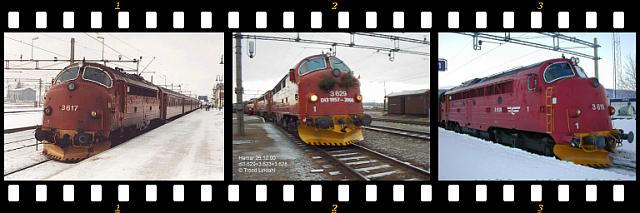 An EMD equipped diesel locomotive.
GM diesel would expand it's 2 cycle lineup with the smaller "53" series that powered everything from large forklifts to city buses. (The 4-53 diesel has been known to repower former gasoline pickup trucks) In the late 1950's, GM diesel introduced the "318" (as in 318 horsepower) or 8V71, it's first V8 diesel. Later they released a V6 version of the 6 cylinder engine. The 6, 6V and 8V comprised the "71 series" family, which well known in the road transportation industry.
 An industrial 8V71 engine.
In 1965, GM diesel changed their name to Detroit Diesel. By 1974, they introduced the "92 series", which had everything from a V6 to a V16. Quite a few semi-trucks were equipped with 12V71 engines. The 12V71 and the larger 92 series engines required 2 superchargers mounted nose to tail.
 A marine 16V92 engine.
By the 1980's, Detroit Diesel offered the 53, 71, 92 and 149 series 2 cycle diesels, the larger V12 and V16 92 series and the 149 series being built for off-road industrial uses only. 8V71 and 6V92 engines were very popular in the motorcoach industry. Many firetrucks sport 8V92 engines.
 A firetruck equipped with an 8V92 engine.
One remarkable feature of the Detroit Diesel 2 cycles was the interchangability of parts throughout a series. For example, the 6-71 originally came with a 2 valve head. A better breathing 4 valve head is found on the 12V71. A cylinder head off a 12V71 fits on a 6-71 with no problem.
 An MCI 102A3 motorcoach engine compartment with an 8V71 engine.
Turbocharged versions of Detroits 2 cycles have either a "T" for turbo, or "TA" for turbo and aftercooled in the name (6V71T, 8V92TA), non turbo models have an "NA" in the name, for naturally aspirated (8V71NA).
 A Detroit Diesel 8V92TA engine.
In the late 1980's the 71 series was phased out of production due to emissions control issues around the same time that Detroit Diesel introduced the Series 50 and 60 engines, Detroits venture into the commercial truck 4 cycle engine market. Detroit Diesel later added electronic controls to the remaining 2 cycle engine offerings but by the early 90's, it became clear that the 2 cycle diesel just couldn't match the newer 4 cycle engines in terms of fuel economy and clean operation even with sophisticated electronic controlls and they were subsequently dropped from on-road use.
By 2000 Detroit Diesel became part of DaimlerChrysler.
Source: RatRedux
Coming next:- Cummins: A man with a mission.

During his 1931 cross country trip to promote diesel engines in trucks, Clessie and his crew almost died during a descent down Cajon Pass on old US66 in California. Their brakes overheated and failed and the truck ended up nearly crashing. Here's a teaser quote written by Cummins on how he was inspired to create the Compression Brake, an essential feature that's still used in diesel trucking today:
The brakes wouldn’t hold. Now running in third gear, I tried desperately to get into a lower speed. Nothing doing. I saw I would just have to ride it out. Well down the long grade by now,I suddenly saw something moving across the road ahead. There was along dark shadow and then a red glow flared in the sky. I realized with new alarm that a freight train was cutting across our path. The truck roared on. Dave and Ford screamed bloody murder in the compartment behind me. And I clung to that steer-ring wheel like a madman. [remaining quote removed] -- Clessie Cummins
- Soviet tank raised from bottom of lake for 56 years...still RUNS!!
 Topic: Love for the 2 cycle diesel (Read 25494 times)


