-
#45
by
libbydiesel
on 28 Dec, 2013 20:38
-
The thermostat is nothing at all like an on/off and instead maintains a very accurate coolant inlet temperature regardless of the temperature of the coolant in the radiator, right up to the point that the thermostat is wide open. The heater circuit is always open and flows freely regardless of thermostat position. The thermostat itself operates as a blending door for the other two water pump inlets; the bypass hose and the return from the radiator. The thermostat has a fairly wide opening range both in temperature and in the distance it moves. As it opens the return from the radiator, the other end of the thermostat simultaneously closes the bypass circuit.
-
#46
by
Gizmoman
on 28 Dec, 2013 21:20
-
The thermostat is nothing at all like an on/off and instead maintains a very accurate coolant inlet temperature regardless of the temperature of the coolant in the radiator, right up to the point that the thermostat is wide open. The heater circuit is always open and flows freely regardless of thermostat position. The thermostat itself operates as a blending door for the other two water pump inlets; the bypass hose and the return from the radiator. The thermostat has a fairly wide opening range both in temperature and in the distance it moves. As it opens the return from the radiator, the other end of the thermostat simultaneously closes the bypass circuit.
Well put. And I believe that's why the temp should not change much. I have no idea why the previous "new" thermostat allowed it to vary so widely but the new, less expensive one seems to hold it quite steady.
If I had a decent IC or a VNT with the proper linkage, I'd be home free even under the most severe conditions. As it is, I'll just keep my foot out of it.
-
#47
by
745 turbogreasel
on 28 Dec, 2013 22:17
-
Both my trucks with huge overkill cooling systems;
Diesel Dodge ~ 7 gallons for 165 HP
350 Chev ~ 500 CI Cadillac 4 core rad
exhibit the gulp of cold 2-3 times a few minutes apart before the water in the rad is warm enough for the thermostat to work stably.
I think quite a few cars do, but the damping in the OEM gauges keeps the driver form seeing it and becoming concerned.
Neither of the above rigs has ever gone 10*F over thermostat temp no matter what i've done.
The Volvo TD, and 6.2 Suburban TD both will heat up climbing at full load if you don't watch it, and have pretty stock cooling systems.
These two, back down till EGT drops 200 degrees, and you have no worries, they'll pull all day.
My Caddy went up to 2/3 on the gauge, and seized a ring, so I turboed it, and I don't think it ever overheated again unless it was blowing a headgasket.
-
#48
by
bbob203
on 29 Dec, 2013 06:17
-
-
#49
by
Gizmoman
on 29 Dec, 2013 07:29
-
I thought VW engines tend to fall into two categories those that operate just over atmospheric boiling point of water and those that don't quite.
17-19psi running pressure + coolant additive takes boiling point significantly over boiling point. So, what's the problem?
As I've said before, try retarding pump a little. Don't 'Giles' pumps offer faster advance rates, and greater maximum advance, so starting slightly retarded from 'book' is not unreasonable IMO.
Why not just try it, measure the results and then go back if no improvement? The slight increase in heat out of the exhaust will be coupled with a bigger decrease in heatloss to coolant, and more pressure doing work ATDC, IMO...
Thanks Mark, I agree, it is worth a try. Besides, I never even hooked up my diesel timing light I just had to have

. Last I checked my timing was at .95 using the dial indicator. If it means anything, pulling out the cold start doesn't seem to change how it runs at all. I know there's no slack and it's working properly.
-
#50
by
Gizmoman
on 29 Dec, 2013 08:11
-
The thermostat is nothing at all like an on/off and instead maintains a very accurate coolant inlet temperature regardless of the temperature of the coolant in the radiator, right up to the point that the thermostat is wide open. The heater circuit is always open and flows freely regardless of thermostat position. The thermostat itself operates as a blending door for the other two water pump inlets; the bypass hose and the return from the radiator. The thermostat has a fairly wide opening range both in temperature and in the distance it moves. As it opens the return from the radiator, the other end of the thermostat simultaneously closes the bypass circuit.
Here's a shot of a cold thermostat in the water pump housing (not that libby's description needs clarification

).
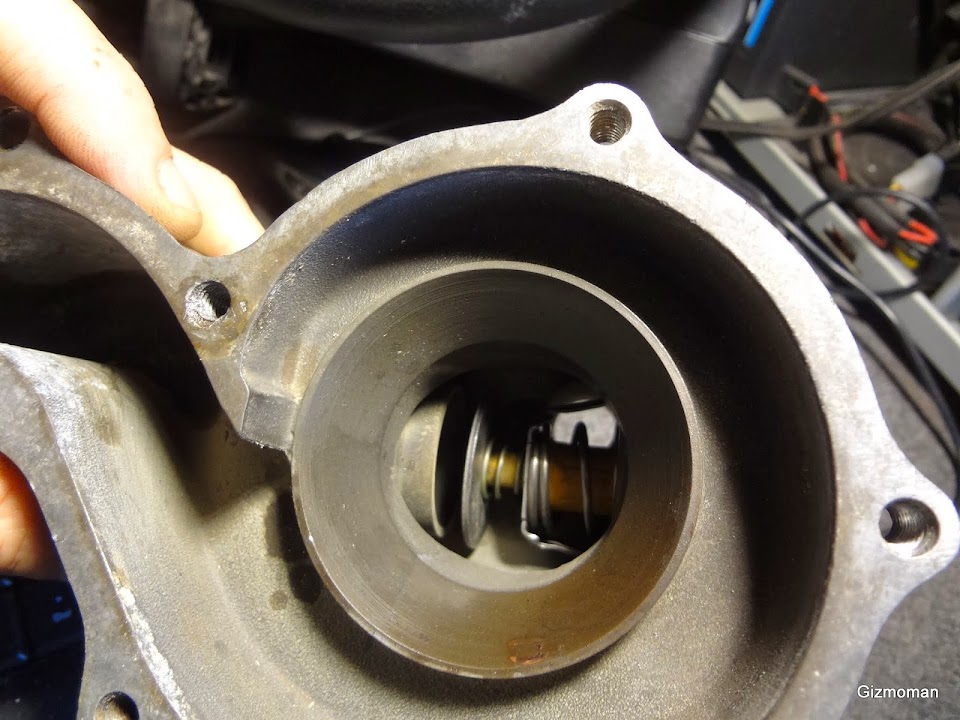
Just for grins, the sheet metal and plastic impellers as well.
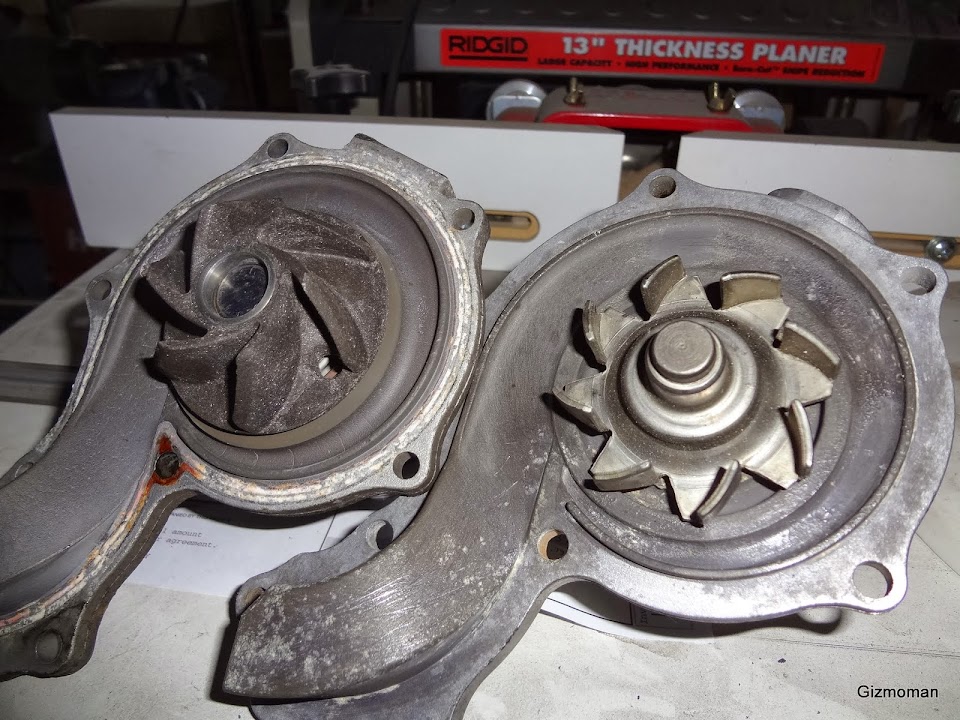
The housings themselves (including the one with the cast vanes) all appear to be identical. The one with the plastic impeller has the closest fit to the housing and I believe was the original one that came from VW (NLA). The sheet metal one has the worst fit to the housing of the three. IMHO, the Vanagon application has to move water a long way to reach the radiator, so a high flow/high pressure pump would be best. As the cast impeller is the closest fit to the housing, it makes sense that it is the preferred choice of the only two styles available. I'd be interested in doing a test but just don't have time right now.
-
#51
by
Mark(The Miser)UK
on 30 Dec, 2013 03:21
-
So everyone agrees then; that the thermostat doesn't switch in and out, and helps to regulate heat to the heater, by sending differing amounts to the radiator. Still varies a bit though...
Strange how the mk2 on Golf stuff did away with the adjustable valve to the heater, and relied on a sponge seal on a flap, but the Quantum/Audi range retained it.
Still, the original point was that the operating temp of the thermostats are not the operating temperatures of a healthy engine...
0.95 setting for the AAZ is higher than any book value, so although it may be fine for your engine; retarding in your case will not appear as extreme as in my engine, and will likely help your engine temperature issue... at less than the cost of some of your proposed alternatives 
-
#52
by
Gizmoman
on 30 Dec, 2013 05:19
-
So everyone agrees then; that the thermostat doesn't switch in and out, and helps to regulate heat to the heater, by sending differing amounts to the radiator. Still varies a bit though...
Strange how the mk2 on Golf stuff did away with the adjustable valve to the heater, and relied on a sponge seal on a flap, but the Quantum/Audi range retained it.
Still, the original point was that the operating temp of the thermostats are not the operating temperatures of a healthy engine...
0.95 setting for the AAZ is higher than any book value, so although it may be fine for your engine; retarding in your case will not appear as extreme as in my engine, and will likely help your engine temperature issue... at less than the cost of some of your proposed alternatives
The van has foam covered flaps as well - well they were foam covered 30+ years ago
Not sure I agree with you on the operating temps being much different than the thermostat. My change of units just proved that. While I am going slightly over 180, it's not much over. And when it is, I believe it's a result of the system not keeping up with the new HP (energy = heat).
I'll give your pump adjustments a go (probably next weekend) and report back. What number(s) do you suggest?
I just re-caulked my valve cover and wanted it to set up for 24 hours before I dump hot oil on it. I'm also working on a new intake filter. The PO had one of those cone filters and personally, I don't trust them much. Besides, I think that's where most of the noise in the cab is coming from - the intake.
-
#53
by
Gizmoman
on 30 Dec, 2013 05:26
-
Interesting take on vnt control.
http://forums.tdiclub.com/showthread.php?t=40167
Thanks b-bob, I've been watching that thread - very interesting. I'm a mechanical guy and while all the stepper motors, boards and code sound interesting, I just don't think along those lines. I'd like to try but not sure if my old brain is up to it
-
#54
by
bbob203
on 30 Dec, 2013 05:54
-
Interesting take on vnt control.
http://forums.tdiclub.com/showthread.php?t=40167
Thanks b-bob, I've been watching that thread - very interesting. I'm a mechanical guy and while all the stepper motors, boards and code sound interesting, I just don't think along those lines. I'd like to try but not sure if my old brain is up to it
If you message him he will send you pictures of his device. He sent me some but asked me not to share them yet as he is trying to work out a deal with the company that makes what he based his design off of or something to that effect. It's nice much nicer than I expected.
-
#55
by
libbydiesel
on 30 Dec, 2013 06:42
-
The thermostat doesn't affect the flow to or from the heater. It regulates the temperature of the coolant entering the engine. Once normal operating temperature is reached, heater output temperature is affected some by load but the effect of the thermostat is only inasmuch as the inlet temperature is kept constant.
The TDI club link is to a discussion of extended service warranties not VNT control.
-
#56
by
bbob203
on 30 Dec, 2013 06:47
-
-
#57
by
Gizmoman
on 30 Dec, 2013 20:12
-
The thermostat doesn't affect the flow to or from the heater. It regulates the temperature of the coolant entering the engine. Once normal operating temperature is reached, heater output temperature is affected some by load but the effect of the thermostat is only inasmuch as the inlet temperature is kept constant.
The TDI club link is to a discussion of extended service warranties not VNT control.
Thanks libby for another good bit of info and clear perspective.
As for the TDI club link, all It sends me to is a discussion on VNT's, and as I had mentioned them earlier, I thought that was the reason for the link. If there is some mention of service warranties, I am missing it somehow. Also missing the relevance, but there must be some
-
#58
by
Mark(The Miser)UK
on 31 Dec, 2013 10:04
-
All sounds frightening to me.
Great photo of the back plate [I may nick it ]
Now that the belt is off you have to put it all back on again, using whatever timing technique you did before.
Then if you do the check I explained earlier, you will know
(i) Does the fuel reach the injectors, and,
(ii) Is the timing basically correct, and probably only needs fine tuning, or is it all way off...
Re the recommended timing, there is nothing definitive, but your value of 0.95 seems quite high for a 1.9. I would try 0.90mm and then 0.85mm, and 0.80mm I don‘t expect you to end up with timing like mine, but you could as an experiment retard timing until engine stumbles, then advance just off it, note the timing and then advance until the engine falters. Again note the timing, and consider bisecting...
Just to clarify re the thermostat operation:
I never said that it varied the flow rate to the heater. I did suggest that the stat‘s hysteresis allowed it to variably control the flow through the radiator, to control the engine temperature which indirectly regulated the heater and that had it operated as a switch, the heater would fluctuate more.
If the 180 you refer to is 180deg F then that is 30 degrees F below boiling point of water. Therefore you are better running pure ionised water in your system as it is actually more efficient at transferring heat.
Many engines including VW’s run above 212F. Hence the provision of the cap with a pressure release of about 17 to 19psi...
Interesting points that come to mind are:
Does the Quantum warm up to operating temperature quicker than the Golf etc, because one can shut off the flow of water to the heater with the valve, except for a little pilot flow.
If the radiators are sized, well within their limits for correct operation of the vehicles, why is it neccessary to have such a larger radiator when a/c is fitted?
-
#59
by
libbydiesel
on 31 Dec, 2013 12:40
-
There is virtually no hysteresis with a properly functioning thermostat. This can be readily observed with the data-logging features of the AHU/1Z TDIs that use the same cooling system. The 'hysteresis' you describe is the classic symptom of a sticky thermostat.
