VDO 323-423 Temp Sender

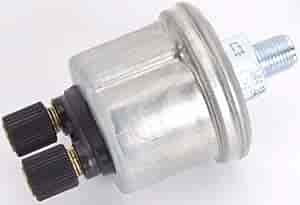
VDO 360-006 Pressure Sender
Thanks for mentioning the black circle. I had circled it to ask if it was a viable port, but then never actually asked.
I guess the next question would be, would it be worthwhile to keep the stock sender at the head and put both the new pressure and temp senders on the flange? Though there have been mixed opinions (as one would expect, of course), the general consensus was that the best pressure reading would come from the head as it would be the lowest pressure reading in the system. If the pressure is okay at the head, then it has to be okay before the head, whereas, in theory, the pressure could be okay (if just barely) at the flange but on the low side at the head. Of course, if it was borderline enough at the flange, I guess it would be foolish to not take that as a bad sign. And beyond that, either way you will be getting a baseline to work from. If the flange is always at a particular bar/psi reading, and all of a sudden it is below that reading, there's your red flag.
So, if I understand correctly:
1. The advantage to putting both senders at the flange is that I at least keep the low pressure warning light in the dash for sub-2000rpm operation (assuming I ground the other, now unused, wire).
2. But if I'm okay with not having any warning light in the dash and just keeping an eye on the gauge, the advantage (as I understand it) of having the VDO pressure sender at the head is that I would be getting the lowest possible reading for the overall system, therefore providing a worst case scenario picture of the system.
3. Either way, I can retain one of the stock pressure senders by using the black circled port on the flange for the temp sender.
But is the sub-2000rpm sender absolutely and unarguably the better sender of the two to keep if you have to lose one? In other words, is it better to have the sub-2000rpm warning vs. the 2000rpm+ warning? I would imagine it would be, as it would account for the lowest possible pressure in the system and provide warning in a worst case scenario situation.
And is the additional warning light contact on the VDO pressure sender of any use? Can it substitute for either of the stock senders and, therefore, maintain complete functionality of the dynamic pressure warning light system?
Here is part of the item description for the VDO pressure sender:
"This sender has the dual terminals for the gauge and the factory oil light."
 Topic: Need clarification on temp/pressure senders... (Read 7920 times)


