-
#90
by
gilligan5000
on 02 Feb, 2010 12:01
-
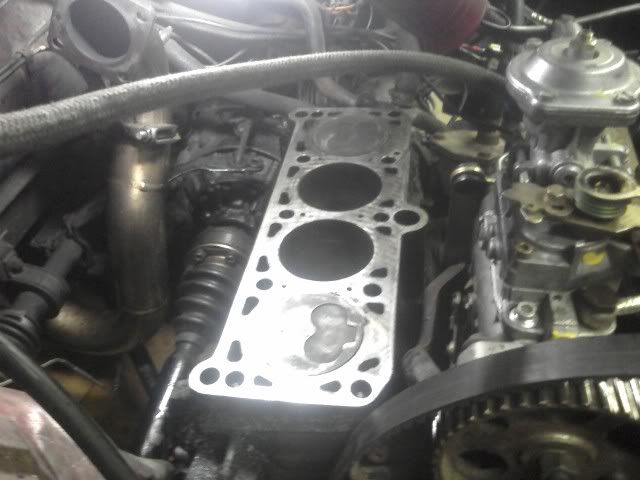
Well, it was a productive week end. I got the 1.9 head built up. Pulled the old head, drilled the steam holes in the block, and got the 1.9 head on.
Here is the block after the steam holes were drilled. The bores look really good, with no ridge at the top yet. Synthetic oil is good stuff. Some of the pistons showed a tiny bit of heat damage in a few small areas along the edges. They were allot better than I expected, since I'm running 25+ PSI boost, and have been occasionally approacing 1500° pre-turbo EGT. But since I didn't see any bore scuffing, I'm leaving them in. I may dial back my fuel a bit though. :wink:
Can you give a little more detail on this...
Congrats on the build so far. And best wishes on your health.
-
#91
by
saurkraut
on 02 Feb, 2010 14:24
-
There are two holes between each cylinder in the 1.9 headgasket. Just plop the gasket onto the block, start the drilling the holes in block using the gasket as a guide. When you have them all started, remove the gasket and finnish each hole. I used a fresh cobalt bit and it had no problem drilling the iron block.
Interestingly, i chose not to use the metal head gasket. Probably the falt of the worn out raceware studs and trying three in a row with no luck in sealing. I really wanted to drive the gosh darn thing and I didn't have a problem with the fiber 1.6td gasket previously. I was running a butt load of boost with the 1.6 head. And I love to feel boost, so I used every chance I got. Actually, the head gave up and the fiber gasket was fine. Every cylinder had a big crack right across the middle. And it manifested itself as a teeny tiney pressurization of the water jacket.
-
#92
by
NintendoKD
on 02 Feb, 2010 17:53
-
Holes in the block good, cracks in the head, very bad, yeah, definately. *rain man* You know the real Rain Man, Kim Peek, passed away in Dec of 09' died before his aging father, sad really. Anywhoo, so how deep do I need to drill said holes? Dirll Press Anyone?

-
#93
by
Rabbit on Roids
on 03 Feb, 2010 07:36
-
Holes in the block good, cracks in the head, very bad, yeah, definately. *rain man* You know the real Rain Man, Kim Peek, passed away in Dec of 09' died before his aging father, sad really. Anywhoo, so how deep do I need to drill said holes? Dirll Press Anyone?
clear through...
-
#94
by
saurkraut
on 03 Feb, 2010 14:53
-
I used a cordless Milwaukee drill and a cobalt bit. Go easy on the pressure so you don't snap off the bit when break through. One of my blocks has half a drill bit rattling around in it.....
-
#95
by
fatmobile
on 03 Feb, 2010 15:19
-
What size steam holes did you drill?
As big as the holes in the metal gasket?
I was thinking I could go smaller,.. maybe 1/8".
Or there is a 7/32 in the drill now.
What size are the holes in the 1.9 engine?
-
#96
by
Smokey Eddy
on 03 Feb, 2010 16:43
-
I drilled to about 1/8th, slightly smaller than the holes in the HG. My thinking was that there isn't a substantial amount of flow going through these holes anyways its to balance the hot bottom with the cooler top.
I didnt want the water/coolant to get under the HG.
-
#97
by
NintendoKD
on 03 Feb, 2010 21:38
-
GREAT info, my 1.8 gasser have this feature as well curiously enough, it will be in the late stages, right before engine start that I will be able to do this. I have to wait to get the correct h/g and then I can drill the holes, unless someone has an old H/G for an AAZ that they will let me use to drill the holes.

-
#98
by
theman53
on 04 Feb, 2010 05:25
-
That is what I did and still have the old aaz gasket. I also painted on it and used it to make my cutout for the oil/water port block since I have a mech head.
I could get it to you for probably $5? PM if interested.
-
#99
by
gilligan5000
on 16 Feb, 2010 09:28
-
I wonder how that protrusion affects flow in a ported head. Your shims and solid lifters might actually end up the better solution, so far as smoothness of flow goes.
Yah, I know  And I'm really not happy about it. But I'm up against the storage season.
I will end up as good as a ported head with the original valve guides. But I know it could be better, and that BUGS me....
The problem that I didn't want to address is the over all geometery of the valves I'd end up running.
There are no valves that are a direct fit, head diameter wise, in a head modified to be a mechanical 1.9 head.
To use VR6 oversized TT exhaust valves as intake valves for the 1.9 head, they needed to be shortened allot to work . The amount that had to be removed would have almost eliminated the top grove for the collets. I could have lived with that. But they were also 0.15mm smaller in head diameter. So it becomes a trigonometery problem figureing how long the stem should be because they'd sit a little deeper in the head, and still end up in the adjustment range of the valve lash shims.
The 1.9 exhaust valve head diameter is also slightly bigger than the 1.6TD exhaste valve. so it has the same problem.
And I really want to try it out befor the snow (salt) starts flying. So its the super long mechanical cam followers for now.
The right answer is custom made valves, and that is not out of the picture. I'll probably go with thinner stems too.
No, the splitty is not mine. But I wish.
Sorry to keep asking you questions, but can you clarify. With these long followers you use the stock 1.9 head everything? or is it still a mixture of random 1.5, 1.6, 1.9 parts...
-
#100
by
saurkraut
on 17 Feb, 2010 16:15
-
Yup, use all the 1.9 stuff: intake, valves, keepers, collettes, etc. I used the 1.6TD exhaust manifold as I had one.
But I recommend using the 1.6 mechanical cam, as the 1.9 cam is a hydro cam, and hydro cams have different profiles.
Ask all the questions you want. No Problem.
-
#101
by
saurkraut
on 13 Mar, 2010 20:35
-
Its raining. The snow is going away. Its almost time to wake this puppy up.

-
#102
by
Powered by Spearco
on 13 Mar, 2010 21:02
-
Oh yeah. Get some
.
-
#103
by
somepunk22
on 14 Mar, 2010 21:45
-
-
#104
by
gldgti
on 15 Mar, 2010 01:36
-
WAY cool :-D
Thought i would ask - a ways back in the thread OP mentioned using stianless bolts for the turbo - I was just thinking that there are a couple of things worth mentioning about this:
1- stainless fasteners can "bond" in areas that are pressed hard against eachother (like threads), especially when used in high heat areas... this could possibly cause issues with dissasembly in the future
2 - on the plus side, the stainless bolt will lenthen at a similar rate to the flanges/castings/spacer, because they are of similar material - unlike a steel bolt which will lenthen much less than stainless - and hence be tighter, but over its lifetime have higher stress heat cycles. hence, the stainless bolt may last longer in service.
